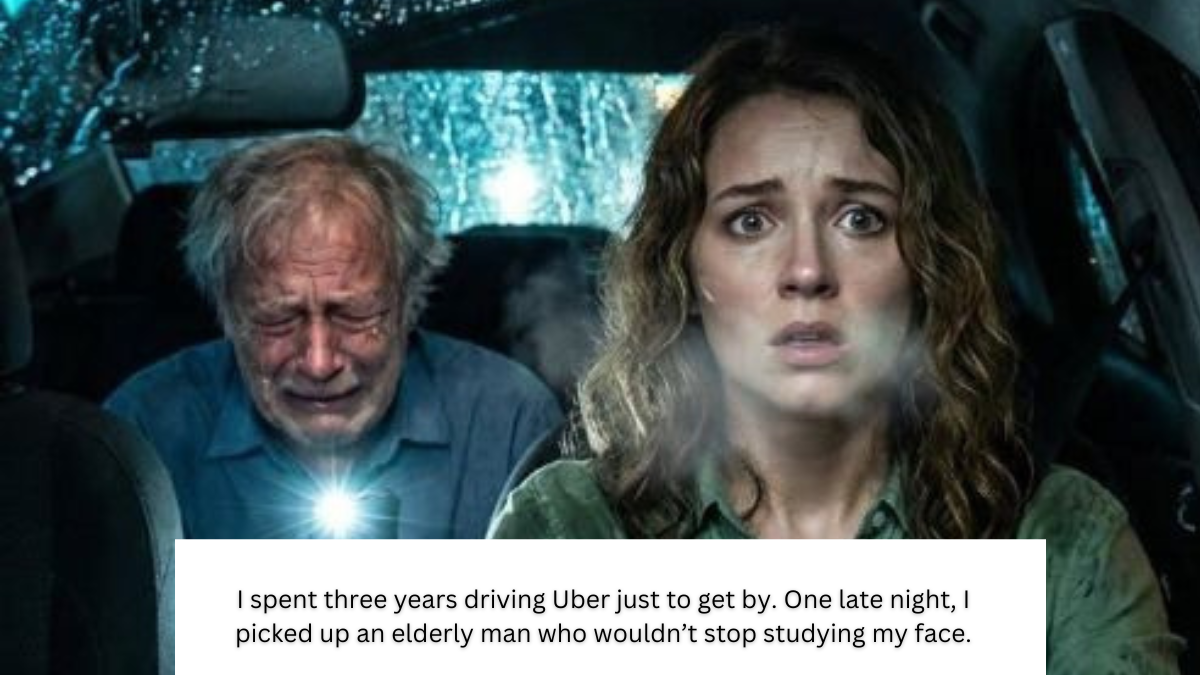


I spent three years driving Uber just to get by. One late night, I picked up an elderly man who wouldn’t stop studying my face.
I spent three years driving Uber just to get by. One late night, I picked up an elderly man who wouldn’t stop studying my face. Finally, he asked softly, “What is your mother’s name?” When I answered, tears streamed down his cheeks. “I’ve been looking for you for 28 years,” he whispered—then he unlocked his phone. What I saw made my chest go cold.
I drove Uber for three years to survive. That’s not a dramatic opening; it’s a simple, unvarnished fact. Survival is a relentless grind, a constant hum of low-grade anxiety that vibrates just beneath the surface of everything. There were no dreams attached to the hum of my worn-out sedan’s engine, no grand plans unfolding with each accepted fare. There was only the tyranny of the immediate: rent, groceries, the electric bill, and the quiet, desperate hope of keeping my head above the murky water that had swallowed everything else in my life.
Most nights were a forgettable blur of faces and destinations. A symphony of airport terminals, pulsing bars in the heart of the city, and the hushed, tree-lined streets of sleeping suburbs. The conversations were a script I knew by heart—polite, shallow, and ending abruptly when a car door clicked shut. I was a ghost in the machine of the city, a transient vessel for other people’s lives, while my own was stuck in neutral.
That night began no differently. The city air was thick with the promise of rain, the streetlights casting long, distorted halos on the damp asphalt. My first fare was a group of laughing college kids smelling of cheap beer and optimistic futures. The second was a silent businessman whose tension was a palpable force in the backseat. The third was a young woman crying softly into her phone. I was a confessional, a chauffeur, a shadow. By the time midnight approached, I was just another tired driver on another long night.
Then, the request came through. A pickup from a quiet, old-money neighborhood on the edge of town. The destination was nearly an hour away. A long fare. Good money. I accepted without a second thought.
When I pulled up to the sprawling, ivy-covered house, an elderly man was waiting under the amber glow of the porch light. He moved with a slow, deliberate grace, dressed in a tailored wool coat that spoke of a different era. He opened the back door himself and settled in, his hands, wrinkled and spotted with age, folding neatly in his lap. The scent of old leather and a faint, spicy cologne filled the car.
The first twenty minutes passed in absolute silence, broken only by the rhythmic swish of the windshield wipers as a light drizzle began to fall. The ride was long, stretching out onto the dark, empty highway that sliced through the countryside. But it wasn’t a comfortable silence.
I could feel his eyes on me in the rearview mirror.
It wasn’t a creepy or threatening gaze. It was something else, something I couldn’t quite decipher. It was a searching, heavy stare, as if he were trying to solve a complex puzzle by studying the lines of my face. I adjusted the mirror slightly, my own eyes flicking up to meet his for a fraction of a second. He didn’t look away. There was an unnerving intensity in his gaze, a profound sadness that seemed to pull at the very air in the car.
Finally, his voice, soft and raspy with age, broke the silence.
“You have your mother’s eyes.”
The comment hung in the air, so unexpected and intimate that it felt like a stone dropped into still water. I offered a tight, polite smile into the mirror, the kind I reserved for customers who overshared. “I guess so. I hear that sometimes.”
He paused, as if weighing his next words with immense care. The hesitation was so profound it made my hands tighten on the steering wheel, a knot of unease forming in my stomach.
“What was your mother’s name?”
The question was a trespass. A stranger in my car, at one in the morning, asking for the name of the most important person I had ever lost. Every instinct screamed at me to deflect, to give a vague answer, to shut it down. But there was something in his voice—a fragile, desperate plea—that broke through my defenses. It was the sound of a man standing on the edge of a cliff.
My own voice was barely a whisper when I answered.
“Her name was Elena.”
The car, which had been silent before, was now plunged into a vacuum. The only sound was the frantic beat of my own heart. I risked another glance in the mirror.
The old man’s face had completely crumpled. It was as if his bones had turned to dust, the carefully composed mask of a gentleman shattering into a million pieces. Tears, thick and unrestrained, spilled down his weathered cheeks. It wasn’t quiet crying; it was a gut-wrenching, silent sob, the kind that comes from a place of ancient, buried pain. A dam of grief, decades old, had just broken.
“Oh my God,” he choked out, the words swallowed by a wave of emotion. “It’s you.”
My foot hit the brake instinctively, the car lurching to a stop on the wet shoulder of the deserted highway. The red glow of the hazard lights pulsed against the darkness. “Sir… are you okay? Do you need a minute?”
He covered his face with his trembling hands, his shoulders shaking with the force of his sobs. The sound was raw, agonizing.
“I’ve been searching for you,” he said, his voice muffled and thick with tears. “I’ve been searching for you for twenty-eight years.”
The world tilted. My heart hammered against my ribs, a frantic, panicked drumbeat. “Searching for me? Sir, you must have me mistaken for someone else. I think you’re confused.”
He shook his head fiercely, his movements sharp and desperate. He fumbled in his coat pocket, his fingers trembling so violently he could barely grasp his phone. “I knew this day would come,” he gasped, his breath catching in ragged hitches. “I just… I never knew it would be like this.”
He finally managed to unlock the screen, his thumb swiping through a gallery of photos with frantic energy. He turned the phone toward me, the bright screen a stark beacon in the darkened car.
And when I saw what was on it—
My breath caught painfully in my chest, a sudden, sharp vacuum where air used to be. My vision swam.
Staring back at me was a photograph I had seen only once in my life, tucked away in the back of my mother’s old jewelry box.
It was a faded picture of my mother, her face radiant and exhausted, holding a newborn baby wrapped in a soft, white blanket.
That baby was me.
My voice was a strangled whisper, barely audible over the drumming rain on the car roof. “Where… where did you get that?”
The old man wiped at his eyes with the back of his hand, trying to regain some semblance of composure. “I took that picture,” he said, his voice thick with emotion. “The day you were born.”
A wave of dizziness washed over me. The car felt like it was spinning, the highway lights blurring into streaks. “That’s impossible. My mother… she told me my father died in an accident before I was born.” I recited the words like a catechism, the foundational story of my life. It was a truth I had never thought to question.
He nodded slowly, a profound sadness settling back into his features. “That,” he said, his voice heavy, “is what she was told, too.”
He took a deep, shaky breath, as if steeling himself to reopen a wound that had never truly healed. His eyes, the same shade of deep blue as my own, met mine in the rearview mirror. He began to speak, his words measured and careful, each one a stone being laid on a path leading back nearly three decades.
Twenty-eight years ago, he was Arthur Vance, a young businessman from a family whose name was synonymous with old money and unyielding power. He had fallen deeply in love with a woman named Elena, a vibrant, fiercely independent artist who saw the world in colors he hadn’t known existed. My mother. Theirs wasn’t a fleeting affair; it was real, serious, and headed toward a future. But their love was a threat to the Vances, who considered a woman with no pedigree and little money to be utterly “unsuitable.” An unacceptable stain on their pristine family legacy.
When Elena became pregnant, Arthur’s family intervened with surgical precision and devastating cruelty.
“My father gave me an ultimatum,” Arthur said, his gaze distant, lost in the painful memory. “A business trip to Asia. He said it was for two months. He said when I returned, we would sort everything out. He promised me he would take care of your mother.”
He wasn’t sent on a business trip. He was effectively exiled, his communications cut off, his letters home intercepted. Back home, his parents went to work on my mother.
“They told her I had abandoned her,” he continued, his voice cracking. “They offered her money—a significant amount—to disappear and never contact me again. They told her I wanted nothing to do with her or the baby.”
My mother, heartbroken and proud, refused the money. She simply vanished, changing her name, moving to a new city, determined to raise her child alone, away from the man she believed had shattered her heart.
To Arthur, they spun a different lie. “When I finally got back, they told me she had taken the money and left. That she had met someone else and didn’t want to see me again. They said she had given up the baby for adoption.”
He pulled up a folder on his phone, the screen illuminating a collection of documents he had saved for decades. Scans of letters he had written to her, all marked Return to Sender. Digital copies of court filings from his early, frantic attempts to find her, all mysteriously blocked and dismissed by judges with deep ties to his family’s influence. And then, the reports—years and years of them—from a private investigator he’d hired as soon as he had his own money and was out from under his father’s thumb. The searches always went cold. The trail always ended at a dead end.
“I never, ever stopped looking,” he said, the passion in his voice cutting through his grief. “But your mother was smart. She was careful. She built a new life, a fortress around the two of you to protect you from a ghost—from me.”
A lump formed in my throat, thick and painful. “She died,” I said, the words feeling like gravel in my mouth. “Five years ago. A sudden aneurysm.”
Arthur closed his eyes, a fresh wave of pain washing over his face. He leaned his head back against the seat, the silence stretching on for a long moment. “I was too late,” he finally whispered to the roof of the car. “I was too late to tell her the truth.”
My mind raced, piecing together the fragmented memories of my childhood. The constant moving from town to town. My mother’s fierce independence and her deep-seated mistrust of wealthy, powerful men. The profound, unspoken sadness that always lingered in her eyes, even when she smiled. All those years, I thought we were alone because we were unwanted. The truth was, we were alone because we were being hunted by a man who loved us.
“How can you be sure?” I asked weakly, my mind still refusing to fully accept the seismic shift that was happening. “How do you know that I’m…?”
He nodded, as if expecting the question. With a trembling finger, he swiped to one last document on his phone. It was a formal report from a genetics lab.
“After I finally tracked down your mother’s death certificate last year, I knew I was close. I found your name. I spent months just… watching from a distance. I hired you for a ride once before, a few weeks ago. You wouldn’t remember me. I sat in the back, just like this, unable to speak. I collected the paper coffee cup you tossed when you dropped me off.”
He angled the screen so I could see it clearly.
It was a DNA test result. Two profiles, compared and matched. At the bottom of the page, beneath a string of genetic markers, was a single, undeniable conclusion.
Paternity Probability: 99.999%
And with that, I broke.
The carefully constructed walls I had built around my heart for twenty-eight years crumbled into dust. The grief for my mother, the ache of a fatherless childhood, the crushing weight of a lonely existence—it all came pouring out. I dropped my head to the steering wheel, and for the first time since my mother’s funeral, I wept.
It wasn’t for money or status. It wasn’t for the life of privilege I might have had.
I wept because, in an instant, my entire story had been rewritten.
I wasn’t a mistake.
I wasn’t abandoned.
I had been stolen.
We sat there for what felt like an eternity on the side of that dark highway, two strangers bound by blood and separated by a lifetime of lies. The only sounds were the rhythmic sweep of the wipers and my own ragged breaths. Arthur—my father—didn’t rush me. He let the storm of emotion run its course, his own silent tears a testament to a grief that had festered for nearly three decades.
When my sobs finally subsided into shuddering breaths, he began to speak again, filling in the vast, empty spaces of my history. He told me about my mother, Elena, not just as the woman who raised me, but as the woman he had loved. He described her laugh, the way she would get a splash of paint on her nose when she was lost in her work, her fierce debates about art and politics, and the unshakeable kindness in her soul.
“She was a force of nature,” he said, a faint, sad smile touching his lips. “My world was black and white—balance sheets and board meetings. She painted it in color.”
He spoke of his own father, Theodore Vance, with a chilling mixture of resentment and pity. Theodore wasn’t just a powerful man; he was a puppeteer, a patriarch who saw his family not as people to be loved but as assets to be managed. An artist with no connections was a liability. A child born out of wedlock was a scandal that could tarnish the precious Vance name.
“He controlled everything,” Arthur explained. “The business, the family’s finances, the politicians, even the judges. To defy him was to be completely cut off, disowned, and left with nothing. I was young, and I was a coward. I thought I could reason with him when I got back. I never imagined the depths of his deception.”
As he spoke, fragmented memories from my own past began to click into place. I remembered being a child and asking my mother why I didn’t look like the other kids’ dads. She would always touch my face gently and say, “You have my eyes, and that’s all that matters.” I recalled her visceral reaction whenever a man in an expensive suit was rude to a waitress, a quiet but intense anger that I never understood until now. She wasn’t just a struggling single mother; she was a woman in hiding, protecting her son from a world of power and cruelty that had tried to erase him.
“I have to know,” I said, my voice hoarse. “Did she… did she ever talk about him? The man she thought left her?”
Arthur shook his head. “I told him about her strength. About how, despite the struggle, she never spoke a bitter word about the man she thought had abandoned her. She simply told me he was gone, and that we had to rely on each other.”
His face hardened for a moment. “She was protecting you. Just as I tried, and failed, to protect you both.”
He then told me about the moment the truth finally came out. His father, Theodore, had a stroke a decade ago. On his deathbed, consumed by a lifetime of regrets, he had confessed everything to Arthur in a rambling, disjointed monologue. He admitted to intercepting the letters, to lying to both of them, to using his immense influence to create the dead ends that had plagued Arthur’s search for years.
“He thought he was unburdening his soul,” Arthur said, his voice laced with cold fury. “But all he did was confirm that I had lost the love of my life and my only child because of his monstrous pride. My search became an obsession after that. It was no longer just about finding you; it was about undoing his final, terrible act.”
I listened, my mind reeling. The faceless, nameless father from my childhood was suddenly a real person, a man who had been cheated as much as we had. The villains of my story were no longer abstract concepts of fate or misfortune; they had names and faces. Theodore Vance. The Vance family.
He didn’t offer me money that night. He didn’t promise to fix my life or shower me with the wealth I had been denied. He offered something far more fragile, far more terrifying, and infinitely more valuable.
“I know I am a stranger to you,” he said, his eyes pleading with me. “I can’t buy back the twenty-eight years my family stole from us. I don’t want to buy my way into your life now. I just… I want a chance. A chance to know my son.”
He held out his hand, not in a gesture of power or ownership, but as a simple, humble invitation. For a moment, I just stared at it—the hand of a man who was both my father and a complete stranger.
Then, slowly, I reached out and took it. His grip was firm, grounding. In that moment, parked under a flickering streetlight on the edge of nowhere, the past and the future collided. The old story of an abandoned boy ended, and a new, uncertain one began.
I put the car in drive and pulled back onto the highway, no longer just finishing a fare. I was driving my father home.
The journey to building a relationship was slow and awkward, like learning to walk again after a long illness. Our first meeting after that fateful night was at a small, unassuming coffee shop, a neutral ground where neither of us felt out of place. We sat in a stilted silence for the first ten minutes, two men from different universes, bound by a shared tragedy.
He studied my face openly, a sad wonder in his eyes. “You have her smile,” he said softly. I found myself watching his hands, noticing how he held his cup with the same deliberate care my mother always had. We discovered small, shared mannerisms—a way of tilting our heads when we were listening intently, a shared dislike for cilantro—that felt like discovering impossible artifacts from a lost civilization.
He told me stories of his life, of the gilded cage he grew up in, and his quiet rebellion that came too late. I told him about my life, the string of dead-end jobs, the small apartment that was always a temporary stop, the crushing loneliness that had been my constant companion since my mother died. I told him about her—her resilience, her secret love of bad sci-fi movies, the way she taught me to cook. He listened to every word as if it were sacred scripture, hungry for details of the woman he had lost and the son he had never known.
Months passed. I quit my job at Uber. It wasn’t because Arthur handed me a check; it was because he helped me secure a loan to go back to school and finish the business degree I’d abandoned years ago. He didn’t rescue me; he invested in me, giving me the tools to rescue myself. For the first time, I felt like I had roots. A history. A truth to stand on. My life was no longer defined by what I lacked, but by the incredible story of what I had found.
Together, we decided to create a lasting tribute to the woman who connected us. We established the Elena Foundation, a scholarship fund dedicated to supporting single parents who wanted to pursue higher education. It was funded quietly, without press releases or fanfare. It was our way of honoring her strength, of turning the pain of our past into a beacon of hope for others. The first time we awarded the scholarship to a young mother with fire in her eyes, I saw my own mother’s legacy staring back at me, and I knew we had done the right thing.
Sometimes, late at night, I think about how close I came to rejecting that ride. How easily that night could have been just another anonymous fare, another face in the rearview mirror. I think about the millions of tiny, random chances that had to align perfectly for our paths to cross.
It reminds me that the most life-altering moments don’t always arrive with a thunderclap. They don’t announce themselves with trumpets.
Sometimes, they get into the back of your car on a rainy Tuesday night.
Sometimes, they ask a single, personal question that changes everything.
And sometimes, they come wrapped in the tears of a stranger who has been searching for you his entire life.
Survival, I’ve learned, is not just about keeping your head above water. Sometimes, it’s about letting the current carry you. It can lead you through storms and darkness, through years of uncertainty and doubt, until it finally deposits you on the exact shore where you were always meant to be.
Even if it takes twenty-eight years to finally arrive.
If you want more stories like this, or if you’d like to share your thoughts about what you would have done in my situation, I’d love to hear from you. Your perspective helps these stories reach more people, so don’t be shy about commenting or sharing.