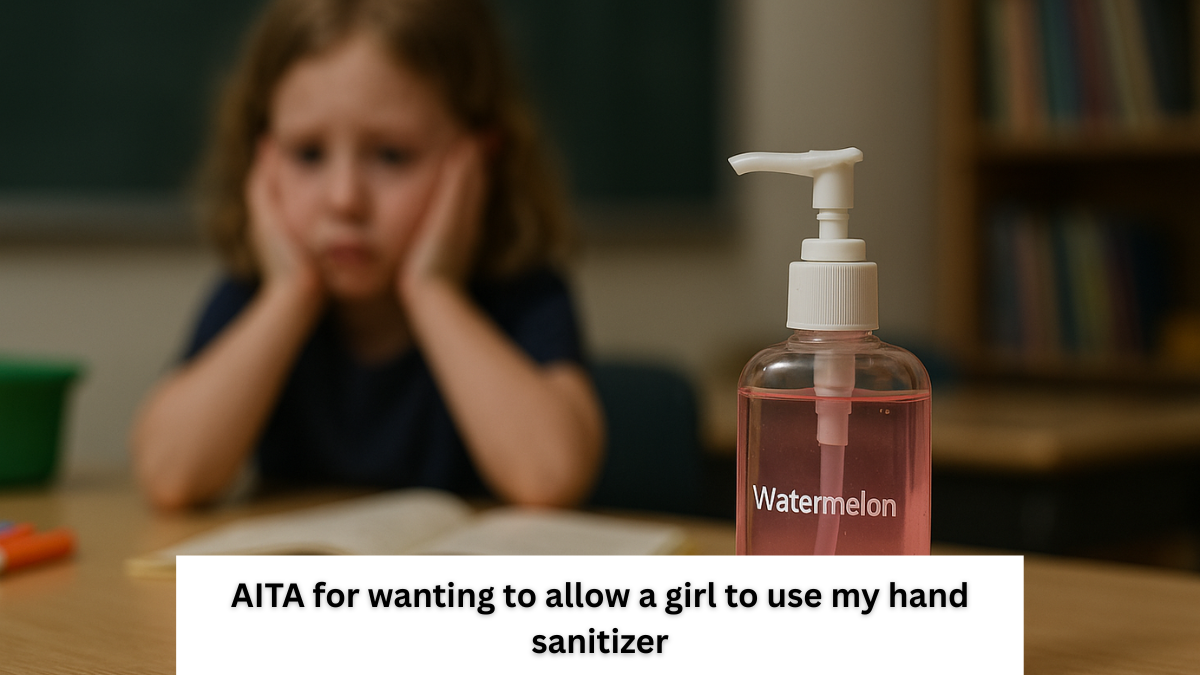
I know the title sounds weird, so I’ll start by providing some background info. I (20F) work at an after-school-program and there’s a little girl (7-8 F) who has some sensory issues (hasn’t been diagnosed with anything, so I won’t attempt to here). One day I was working with her, she started to melt down as my coworker (18F) gave all the kids hand sanitizer due to being averse to the smell and texture. I let her use mine (the Touchland Watermelon one from Ulta) and she calmed down, so I told her that in the future, she could just ask me to use mine. Well, today, she asked if she could use my hand sanitizer. I of course said yes before my coworker said she could just use the school’s. The girl calmly explained that she didn’t like the smell and texture, but my coworker told her “I don’t care” and told me not to let her use it because she needed to learn that she couldn’t always get what she wants and it would result in the other kids wanting to use it. To be clear, I would have no issue with the other kids using it and am all for teaching kids that they can’t always get what they want, but I just don’t think this is the time or place to do so. However, me being neurodivergent could cause me to be biased, so I wanted to get some more neutral perspectives as to whether I was the AH

Was I Wrong for Letting a Child Use My Hand Sanitizer?
A childcare worker asks if she’s wrong for letting a sensory-sensitive student use her personal hand sanitizer instead of the school-issued one.
A simple bottle of hand sanitizer turned into a workplace argument over empathy, boundaries, and whether a child should “just get used to it.”
The Backstory and Early Dynamics
The writer works at an after-school program and interacts regularly with a young girl who has sensory sensitivities. The school requires kids to use hand sanitizer, but the standard type bothers this child — the smell and texture trigger discomfort and distress.
One day, when she was melting down, the writer let her use a watermelon-scented Touchland sanitizer instead. It helped — and from then on, the child knew she had a safe alternative.
The Moment Things Shifted
On a later day, the girl politely asked if she could use the same sanitizer again. The writer said yes — but a coworker shut it down immediately.
The coworker insisted she use the school’s sanitizer and told the girl, “I don’t care.” The reasoning?
She needed to “learn she can’t always get what she wants.”
The Final Confrontation
The writer tried to quietly advocate for the child, explaining that the sanitizer caused sensory distress — not a preference issue.
But the coworker doubled down, telling the writer not to allow exceptions because it would make other kids want it too, and because “life doesn’t cater to preferences.”
The Fallout
The writer now feels stuck — torn between accommodating a child’s legitimate sensory needs and maintaining workplace consistency.
She worries her own neurodivergence might make her overly empathetic — and asks the internet:
Was I wrong for letting her use my sanitizer?
What Reddit Thinks
This story would likely get NTA (Not The A●●hole) from most commenters.
Sample realistic responses:
 “This wasn’t a power struggle — it was a sensory accommodation. You weren’t spoiling her, you were supporting her.”
“Your coworker isn’t trying to teach resilience — she’s just being dismissive. The kid wasn’t demanding luxury, she was avoiding distress.”
“If other kids want it, then explain WHY she uses it. Kids understand fairness doesn’t mean identical treatment.”
Some might note workplace policy concerns, but empathy wins in most eyes.
A Final Thought
In schools, does “treating everyone the same” really teach fairness — or does recognizing individual needs teach compassion?