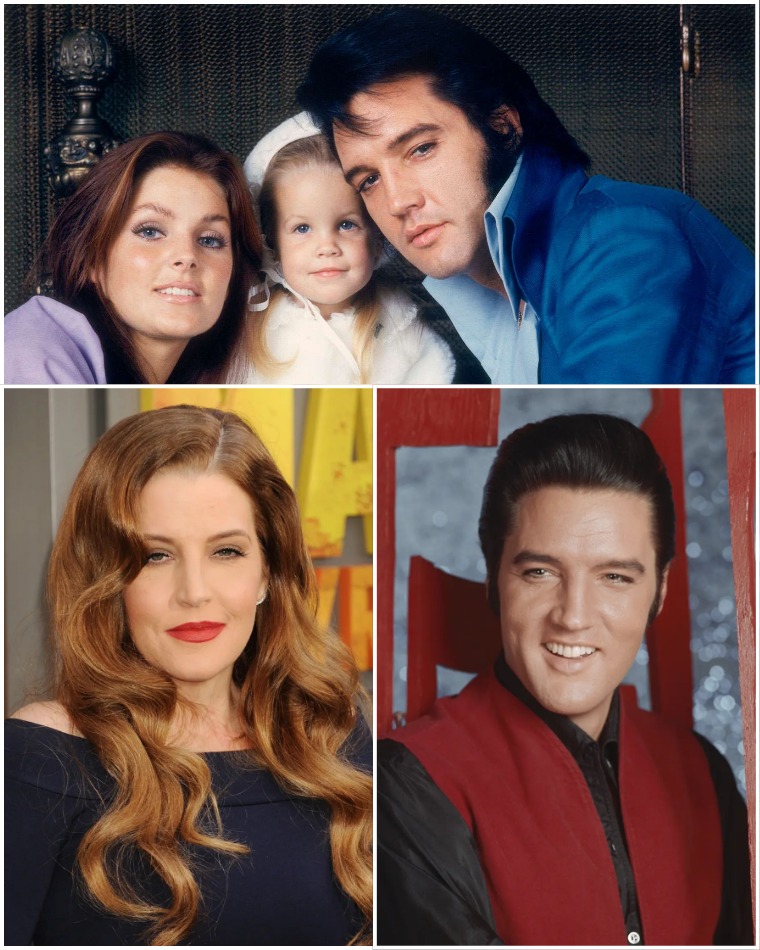
On a quiet morning in August 1977, the world was devastated by the news that Elvis Presley—the King of Rock and Roll—was gone. But for nine-year-old Lisa Marie Presley, that day would become the defining moment of her life. More than just a global icon, Elvis was her father, her hero, her safe place. And when she discovered him unconscious in the bathroom at Graceland, her world shattered irreparably.

In the hours that followed, Lisa Marie clung to his memory in the most intimate way possible: by kneeling beside his open casket at the public wake, whispering words meant only for him. Friends and family say she wouldn’t leave his side. In that moment, she wasn’t the daughter of a legend—she was just a little girl begging her father to come back. That grief, raw and consuming, never truly let her go.
A Life Defined by Loss
Throughout her life, Lisa Marie Presley walked a delicate tightrope between fame and trauma, always under the public eye, but never quite free to be her own person. Interviews, lyrics, and close friends all reveal the same truth: she never stopped mourning Elvis.
Her daughter, actress Riley Keough, has said in recent interviews that Lisa Marie’s grief remained unresolved. “She never got over him,” Riley admitted. “It was like she was frozen in time.” Riley described her mother replaying Elvis’s songs late into the night, often alone, sometimes with a drink in hand, sometimes in tears.
Lisa Marie once confessed that she felt most at home at Graceland, surrounded by her father’s belongings, his scent, his piano. The mansion, once bustling with life, became a shrine and, in many ways, a prison.

The Weight of Inheritance
Being Elvis’s only child came with unimaginable pressure. Lisa Marie wasn’t just a celebrity kid—she was a living extension of American myth, the keyholder to Graceland, and the keeper of the Presley legacy. That role brought millions of fans to her doorstep, along with paparazzi, opportunists, and enormous expectations.
She fought hard to protect her father’s name, but the cost was high. Her personal life was marred by tragedy and instability: a series of failed marriages (including one to Michael Jackson), high-profile lawsuits, tabloid scandals, and financial strain. But the most devastating blow came in 2020, when she lost her son Benjamin Keough to suicide. He was only 27.
The pain of losing her child—so much like her own loss of Elvis—was too much. Lisa Marie’s public appearances after Benjamin’s death became increasingly rare. When she did appear, she seemed fragile, withdrawn, and grief-worn.
A Final Farewell Foreshadowed
In January 2023, Lisa Marie Presley attended the Golden Globe Awards, standing alongside her mother Priscilla and Riley to support actor Austin Butler’s portrayal of Elvis in the acclaimed biopic. It was supposed to be a moment of celebration, but viewers noticed something haunting. Lisa Marie’s speech was slurred. She clung tightly to her companion’s arm. Her eyes looked distant.
Only two days later, she suffered a cardiac arrest and was rushed to the hospital. Despite medical efforts, she passed away on January 12, 2023, at the age of 54. The world lost not just a famous name, but a woman whose life had been shaped—perhaps doomed—by the unbearable weight of grief.

The Presley Curse, or a Human Tragedy?
Fans and media alike have speculated about a so-called “Presley Curse”—a string of untimely deaths, broken relationships, and emotional turmoil across generations. But perhaps it wasn’t a curse at all. Perhaps it was simply grief unhealed, a cycle of trauma passed down like a family heirloom.
Lisa Marie’s story is not just about celebrity—it’s about how deeply we can love, and how impossible it can be to move on from devastating loss. She was not only Elvis’s daughter; she was his greatest devotee, a woman who lived every day in his absence.
She now rests at Graceland, beside her father and her son, a full circle of heartbreak and reunion. And for those who admired her, her music, and her vulnerability, Lisa Marie Presley remains a symbol of what it means to carry both a legacy and a wound.